ADR0006 - Change Tracking
Problem Statement
Framework 2.0 should be agnostic if the service is cattle or pets. It should enable service maintainers and operators to manage services with a low amount of customization and services with a high amount of customization. It should support low-risk services and high-risk services that need manual reviews before upgrades. Not every cluster is the same and it’s not always guaranteed that the test instances are exactly the same as the production instances.
We want to make service operating and development as transparent as possible. We want to be able to see what changed between service releases and framework releases.
We want to be able to do tiered releases of services and the framework.
High level goals
-
Support service maintainers and operators by allowing full change visibility from development to production clusters.
-
Allow manual reviews of service upgrades and framework upgrades.
-
Allow tiered automated releases of services and the framework.
-
Keep components as modular as possible to reduce the blast radius of changes.
Proposal
Change tracking system
Everything is implemented as a Kubernetes controller and the state of the system is stored in Kubernetes CRDs.
All controller components are managed and versioned by Project Syn. Project Syn is a GitOps Framework and cluster inventory system already in use by VSHN. It allows fine-grained control over the controller versions and makes changes visible in Git.
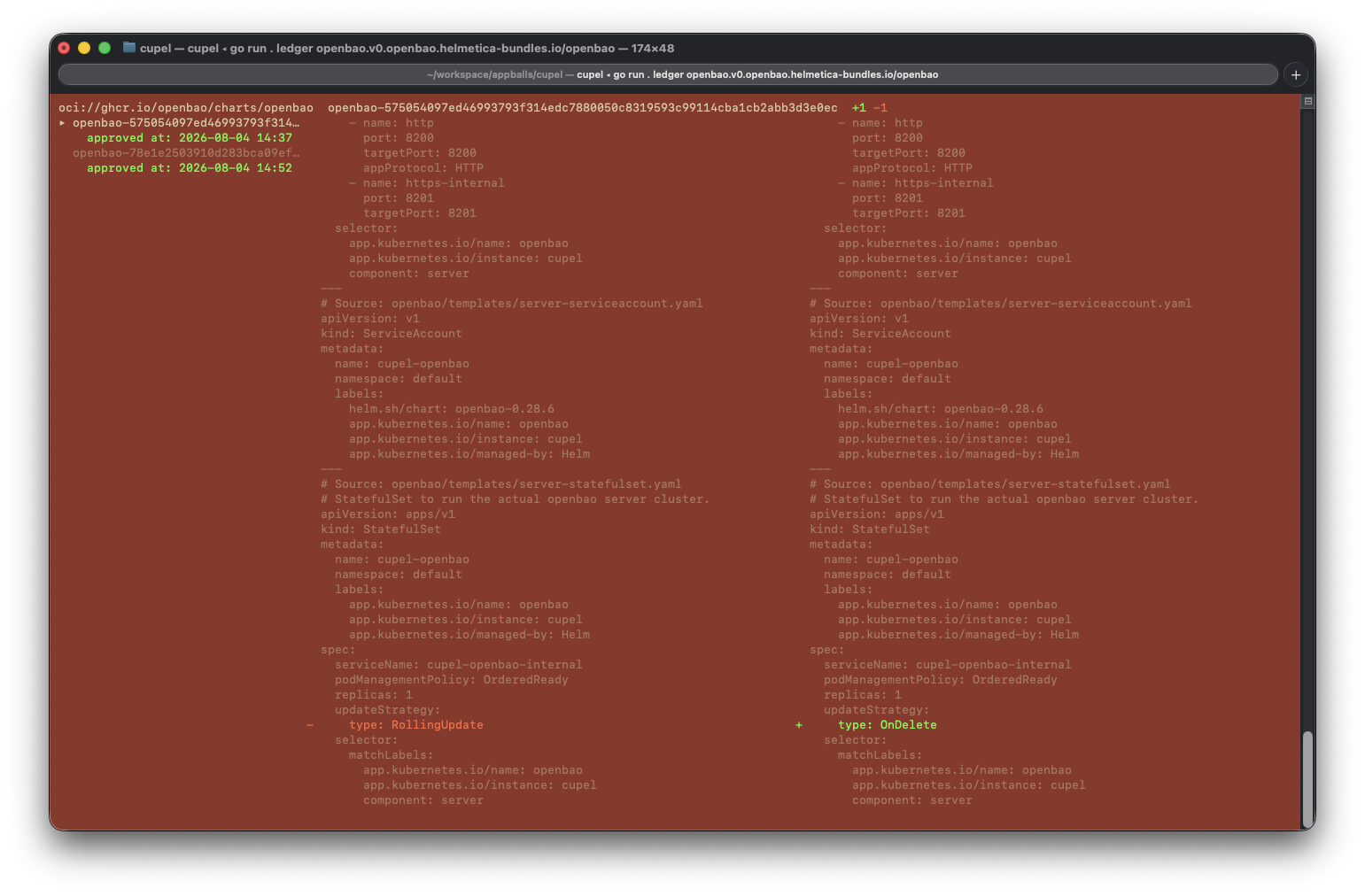
Since Project Syn is too static for user self-serviced services, we will implement a change tracking system for the services in the Kubernetes API. A snapshot is created from every claim change consisting of the claim values and the OCI image digest of the chosen service package.
The snapshots have an approval timestamp, the revision with the highest approval timestamp is considered the current revision of the service instance. If the user chooses automatic approval, the snapshot is automatically approved and the service instance is upgraded to the new revision. If the user chooses manual approval, the snapshot is created but not approved and the service instance stays on the current revision until the user approves the snapshot.
apiVersion: helmetica.io/v1
kind: InstanceRevision
metadata:
  name: openbao-575054097ed46993793f314edc7880050c8319593c99114cba1cb2abb3d3e0ec (1)
spec:
  approvedAt: "2026-08-04T12:37:47Z" (2)
  ociUrl: oci://ghcr.io/openbao/charts/openbao
  values:
    csi:
      agent:
        enabled: false
      enabled: false
    global:
      openshift: true
    injector:
      enabled: "false"
    server:
      authDelegator:
        enabled: false
      dataStorage:
        size: 1Gi
      image:
        repository: openbao/openbao-ubi
version: 0.28.6@sha256:b3a8d99a56ffa36174b3848917ca849311f890d3bc2214245c88c270a54d0795 (3)| 1 | The name of the snapshot is a hash of the URL, values, and version. |
| 2 | The timestamp when the snapshot was approved. Can be empty if the snapshot was created but not approved yet. |
| 3 | The OCI image digest of the service package that was used to create the snapshot. |